Rolteca
A Spanish-language tabletop RPG archive I started in 2015, now on its fourth version.
“I started Rolteca while studying for my DAM vocational degree, to have the games and play aids I was looking for in one place. Four versions later, it's still growing with me.”
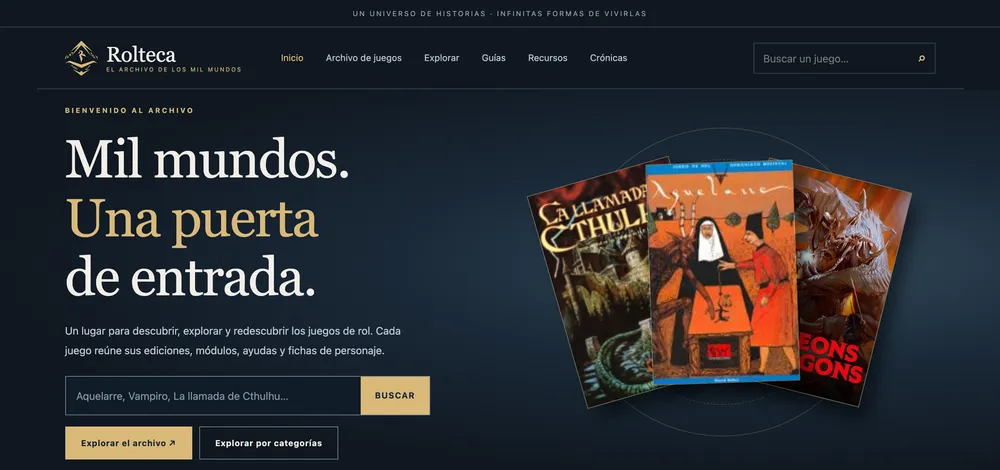
- games
- 896
- modules and adventures
- 2,243
- character sheets
- 1,053
- play aids
- 2,001
Rolteca is an archive of tabletop role-playing games in Spanish. Each game has its own page with the editions, modules and adventures, character sheets and play aids published for it, plus a classification that lets you search by genre, era, rule system or theme. It currently holds 896 games, and you can visit it at rolteca.com.
What I wish I’d had in one place
The idea came up in 2015, while I was studying for my DAM degree. I wanted a site where I could find the rulebooks, adventures and play aids I needed to play, sorted by game, and I wanted that site to be useful to the rest of the community too.
Since then Rolteca has had four versions, each one built with what I knew at the time. That also makes it the most honest record I have of how I’ve grown as a developer. The story of each version is further down, with the screenshots that survived.
What’s in the archive today
The game archive can be filtered by genre, system, era and theme, narrowed down to free games or to games with character sheets, modules or play aids, and sorted by name or by amount of material. Search for “vampiro” and you get the five versions of Vampire in the catalogue, from The Masquerade to the PbtA take.
The game pages are what has changed the most. The Aquelarre page, for example, doesn’t just list its 132 modules. It explains what each edition brings, which adventure works for a table that has never played and which ones are meant for long campaigns. For people who don’t know where to start there’s the “Nunca he jugado” (I’ve never played) section, and for those who’d rather browse, Explorar organises the whole archive by genre, themes, era, rules family, format, origin and inspiration.
Recursos has hand-picked selections, such as free horror adventures you can play in a single session, or Aquelarre adventures sorted by era, tone and length.
From collecting material to helping people choose
The early versions of Rolteca were mostly a place to pile things up. Over the years I’ve become more interested in helping people choose. Having 132 adventures for one game is great, but someone about to run their first session gets more out of knowing which one plays in an afternoon with newcomers.
You can also tell which games I’m drawn to. I have a soft spot for the BRP percentile system (Call of Cthulhu, Far West or Omertà), and Call of Cthulhu is the game with the most material in the archive, with 176 modules.
Where the material comes from
The current archive has been built since 2020 with material shared by the community or published with its authors’ permission. When a resource has an official source, the publisher or the author, I prefer to link to it rather than host a copy. Paid rulebooks, supplements and adventures are not published without authorisation, and anything that turns out to be under copyright is taken down. The details are in the editorial methodology (in Spanish).
I also learned to write
I wrote Rolteca’s first Crónicas when I was just starting out with copywriting. They’re still there as they were, and the difference from the current game pages and guides is easy to see. Writing for Rolteca has made me think about who’s reading, which is almost always someone with a session coming up and little time to prepare it.
Four versions, four stages
2015 · DAM vocational degree
Java + PrimeFaces
I built the first Rolteca while studying for my DAM degree (multiplatform application development), using Java and PrimeFaces because that was what I had at hand. I was very junior and it showed everywhere. There was no repository, changes were uploaded to the server by hand, and not a single screenshot of that version survived. The idea, though, was already the same as today, gathering in one place the games and play aids I kept looking for.
2017
Angular + Node
Two years later I rebuilt it by splitting the pieces, an Angular app for the website and a Node API for the data. It was the first time I treated the front end and the back end as separate projects, with the upside of changing one without touching the other and the cost of maintaining two things when you're the only person behind them.
2020
Gatsby + Strapi
In 2020 I moved to a static site generated with Gatsby, with the content in Strapi, a headless CMS. That was when Rolteca stopped being an application and became an archive, with one page per game and its modules and play aids hanging from it. It's the first version that left a trace on archive.org.
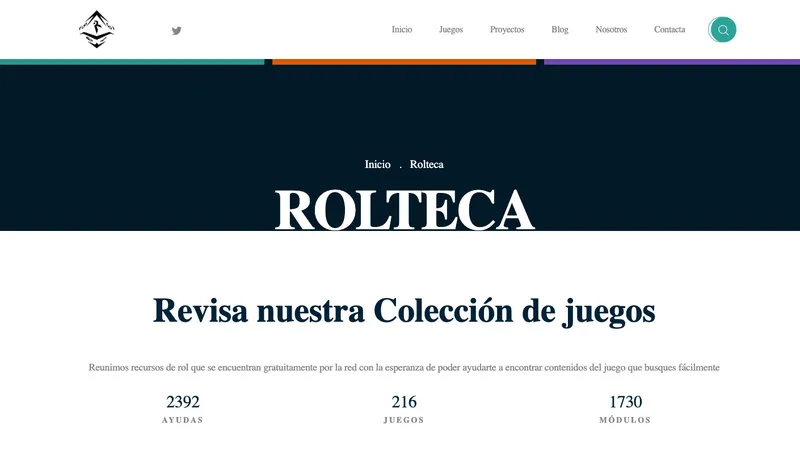
In April 2022 it had 216 games and 1,730 modules. 2026
Astro
The current version is built with Astro, and it's the first one where a good part of the work wasn't in the code. Every game is classified by genre, era, system, format, origin and inspiration, and the game pages explain where to start and which modules suit each table. It's the Rolteca I would have liked to find in 2015.
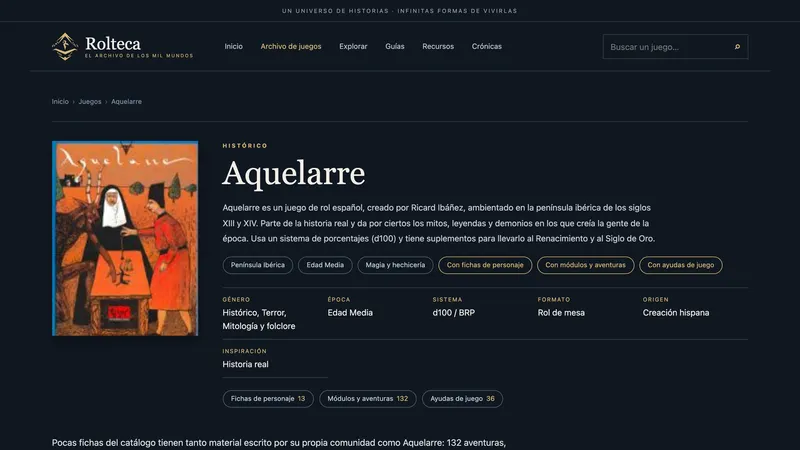
Today it has 896 games and 2,243 modules, about four times as many games as in 2022.
More than code
As a developer
Four versions in eleven years, each one built with what I knew at the time. Rolteca is where you can best see how my way of approaching the same problem has changed.
As a roleplayer
At first I wanted to have everything. Now I care more about helping people choose which adventure works for a first session or how to get into a game. And my soft spot for d100 systems shows.
As a writer
I wrote the first Crónicas when I was just starting out with copywriting. Today's game pages and guides are written for whoever is going to run a session that same week.