De 0 a desarrollador con IA
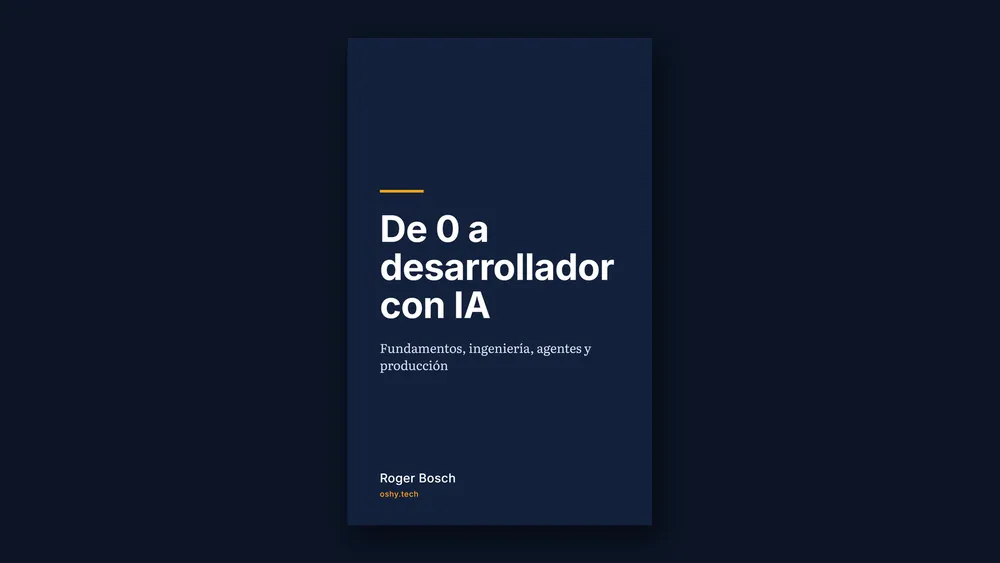
A 794-page book, written in Spanish, for learning to program from scratch now that an agent writes much of the code. Fundamentals, engineering, agents and production, with five guided projects.
- pages
- 794
- chapters
- 51
- parts
- 10
- guided projects
- 5
“De 0 a desarrollador con IA” (From 0 to developer with AI) is a book for learning to program from scratch and getting as far as building real software and putting it into production with the help of AI. It has been available on Amazon in Kindle format since 24 November 2026.
The book is written in Spanish, and there is no English edition.
I wrote it from my own training notes and from the notes I have kept about working with AI. The idea that runs through it is that AI keeps getting better at the mechanical part of programming, and that what still holds its value is the judgement to understand what you build, decide what to ask an agent for and review what it gives back.
Who it is for
For people starting from scratch who want to end up working as developers. Also for people who already program and want to bring AI into the way they work without losing their judgement.
You will not find a collection of prompt tricks. The book rests on the fundamentals that do not expire and applies them with today’s tools.
Why it starts without AI
The programming fundamentals with Python are taught without AI on purpose. If you cannot read what an agent hands back, you have no way of knowing whether it is right, and that judgement is built by writing and understanding your own code before delegating it.
From there AI comes in layer by layer. First how the models work, then how to work with agents, and finally how to hold it all up with tests, infrastructure and security.
Five guided projects
The book ends with five projects built step by step.
- A booking API in Go, with clean and hexagonal architecture.
- An AI terminal assistant.
- The booking website, in TypeScript.
- A mobile app with Kotlin Multiplatform.
- A RAG assistant in Python that answers from your own documents.
The code, in a public repository
All the code from the book is in a public GitHub repository, with examples in Python, Go, TypeScript and Kotlin. Every example that uses AI has a simulated mode, so you can follow the whole book without paying for any API.
Where it reads best
The book has a lot of code, and it does not read well on a small e-ink reader. It works better on a tablet, in the Kindle app or on a computer.
The route, part by part
Part I
Getting started
Before writing any code. How to learn, how to study with AI without letting it think for you, and what changes in the job when a tool generates the code.
Part II
Programming fundamentals
Computational thinking, the core concepts, languages, systems and networks, and good practices from the start. It uses Python and no AI, and ends with a first project.
Part III
Software engineering
The software life cycle, requirements, spec-driven development, programming paradigms and design principles.
Part IV
Architecture
Clean and hexagonal architecture in Go, with a booking system that grows chapter by chapter, a guided case with its own challenge, and an introduction to distributed systems and events.
Part V
AI fundamentals
What artificial intelligence is, how language models work, prompting and multimodality, the ways to adapt a model, and responsible AI.
Part VI
Developing with agents
From autocomplete to agents. Context, MCP, skills and rules, how to integrate AI APIs into your programs and how to orchestrate several agents.
Part VII
Quality
Testing with and without AI, refactoring and technical debt, metrics, code review and documentation with AI, observability and usability.
Part VIII
Infrastructure
Databases, containers, continuous integration and deployment, the cloud, and what it takes to bring AI to production.
Part IX
Security
Secure development, the OWASP Top 10 for the web, security in APIs and in LLM applications, and AI as an ally in security.
Part X
Guided projects
Five projects to bring it all together. An API in Go, an AI terminal assistant, a website in TypeScript, a mobile app with Kotlin Multiplatform and a RAG assistant in Python.
Tecnologías utilizadas
The Amazon link is an affiliate link. As an Amazon Associate I earn from qualifying purchases.