Arte y Destreza
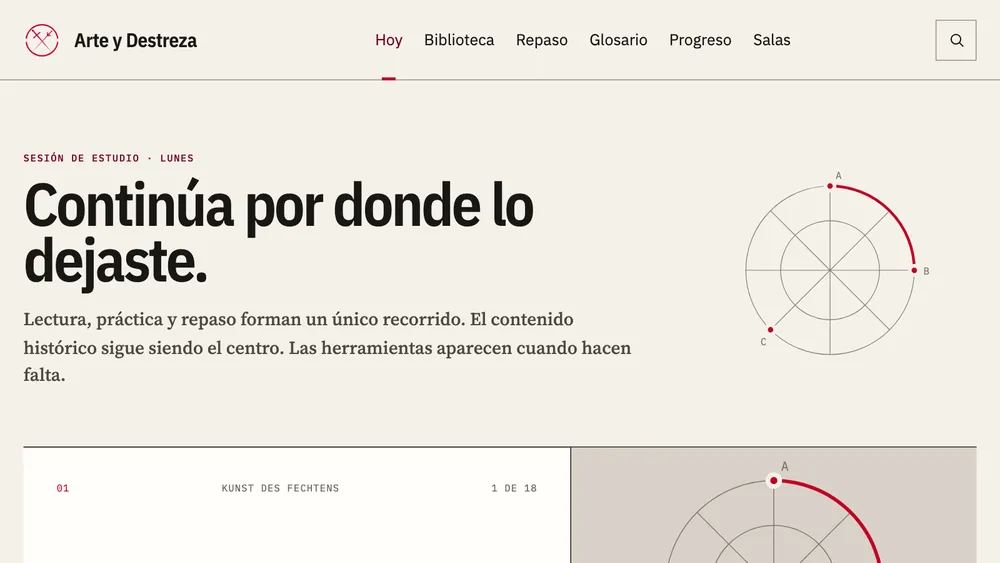
The historical fencing notes I study with used to live in two PDFs. Now they are an interactive study notebook with lessons, spaced review, mini-games and a map of clubs.
- lessons
- 42
- glossary terms
- 169
- review flashcards
- 338
- clubs on the map
- 112
Arte y Destreza is a site for studying the fundamentals of historical fencing in Spanish: the Verdadera Destreza with the rapier and the Kunst des Fechtens with the longsword. It grew out of the notes I study with as a student at Duo Bellum, one of the clubs of the Associació Catalana d’Esgrima Antiga (ACEA), and you can visit it at arteydestreza.oshy.tech.
Notes made for reading, not for studying
At ACEA the syllabus comes in two PDFs. They are good documents, written by the best instructors you could ask for, but a PDF assumes you will read it from start to finish and in order. Between classes I needed something else. I wanted to get back to a concept quickly, check whether I really remembered the guards and see the diagrams in motion.
The idea was to treat the syllabus as what it is, study material, and apply to it what we know about how people learn anything else.
How it was made
Splitting the syllabus into pieces you can study in one sitting
The first job was to read both PDFs carefully and decide where each concept starts and ends. A chapter that mixes footwork, guards and distance is hard to study in one go, so each idea became a lesson of its own, short and with a single goal. There are 42 in total, split between longsword, rapier and the concepts they share, and they follow the order of the notes so the learning path still makes sense.
Bringing the vocabulary to the surface
Historical fencing has a lot of vocabulary. In longsword the terms are German, such as Meisterhau, Winden or Langenort, and in the Destreza it is the Spanish of the treatises by Carranza or Pacheco de Narváez, with its atajos, medios de proporción and líneas infinitas. If you do not know the words, you do not understand the explanations. That is why each lesson collects its terms with a short definition and the alternative names that appear in the sources. The 169-term glossary and the flashcards come from there.
Asking instead of rereading
Rereading gives a feeling of mastery, but recalling without looking is what makes the content stick. The 338 flashcards rely on active recall. They ask the question, you try to answer it and only then do you see the answer. Then you rate how well you knew it from four options, and spaced review uses that to decide when the card comes back. What you get wrong shows up again soon and what you know well gets spaced further apart.
Seeing the geometry, not just reading it
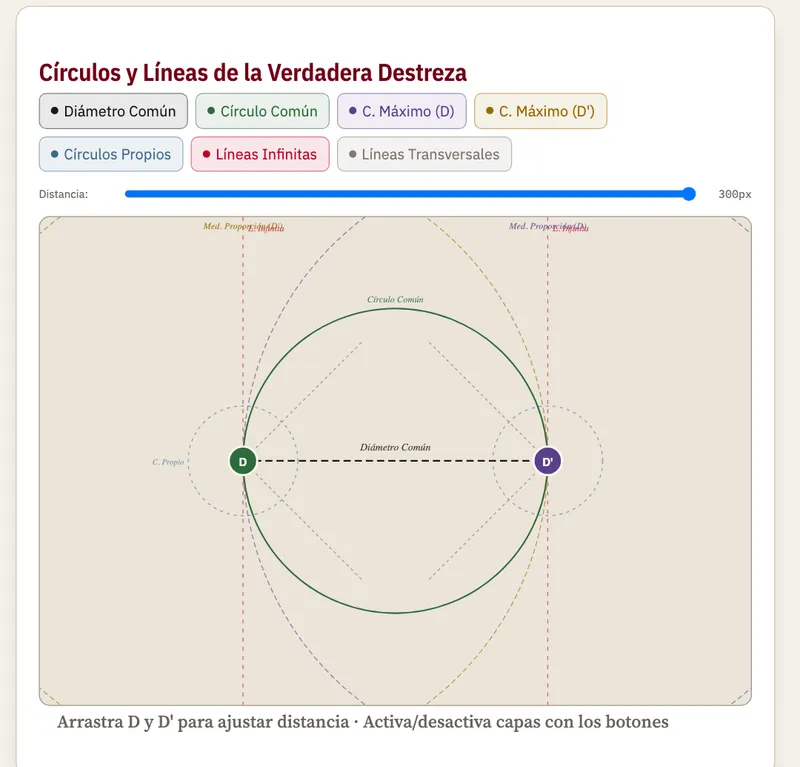
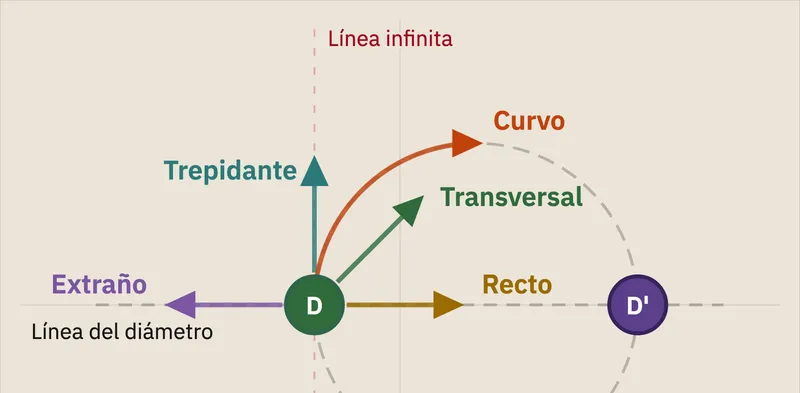
Much of the Destreza is explained with circles, diameters and angles, and a paragraph describing them falls short. The lessons that need it pair the text with a diagram you can manipulate. You move the two fencers, switch each layer on or off and see what changes with distance. Text and image reinforce each other.
Practising in context
Knowing the definition of a guard is not the same as knowing when to use it. The five mini-games set out specific tactical situations, such as an attack along the diameter or an opponent in a particular guard, and ask you to choose the right response. Each one is linked from the lesson that explains it, so practice comes right after reading.
Making progress a decision
Opening a lesson does not count as having learned it. To mark it as completed you have to do so on purpose, and the home page takes you back to the last lesson you opened along with the flashcards you have pending. Everything is stored in the browser, with no accounts or sign-up, and it can be exported and imported from the progress page.
Every lesson says where it comes from
The technical content is what is taught at ACEA, and the credit goes to ACEA and its instructors. Without the work behind those two PDFs, this site would not exist. Each lesson has a block with its source, and the site makes it clear that it is a personal study project and not an official website. If something has been transcribed wrongly, the mistake is mine and there is a way to report it.
From studying to training
The last step was the club directory. What helps someone who wants to start the most is not a syllabus, but knowing where there is a club nearby. The directory builds on Arcensis’s map of clubs, started by David Lucas of Sala Talhoffer, organises it by region, city and discipline, and marks which listings have been verified and which have not. It does not act as an intermediary or sell anything. It sends you to the club so you can talk to them directly. An automated check runs every week to confirm that the clubs’ websites are still up.
From PDF to study notebook
Starting point
Two PDFs of notes
The basic longsword syllabus, 21 pages long, and the rapier notes, 32 pages long. They work well to read from start to finish, but not to search, practise or review.
Step 1
The syllabus, lesson by lesson
The PDFs become 42 lessons, each with its own page, its terms and its source, and the static diagrams become interactive.
Step 2
A notebook that remembers for you
Then come the 338 flashcards with spaced review, the five tactical mini-games and progress saved in the browser.
Step 3
Where to train
A directory with a map of the historical fencing clubs in Spain, showing what each one practises, how to contact it and whether its listing has been verified.
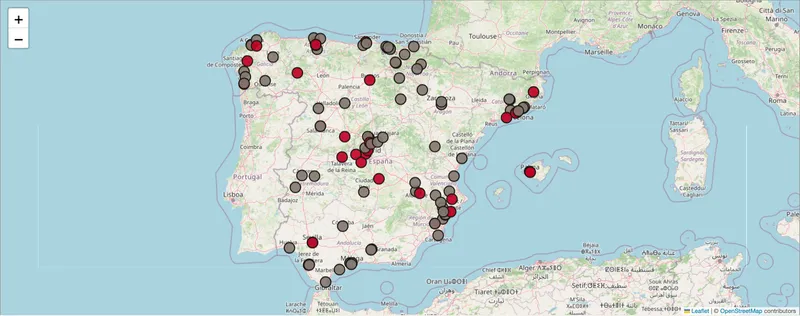
112 clubs in 91 towns across all 17 Spanish regions.
What changes for the student
Find
A global search and a glossary of 169 terms, instead of flipping through two different PDFs to find out what Meisterhau or atajo means.
Practise
The diagrams move and the mini-games put you in a specific situation. Each one is linked from the lesson that explains it.
Remember
Flashcards come back just as you are about to forget them, and the progress page shows how far you have got in each discipline.